All guides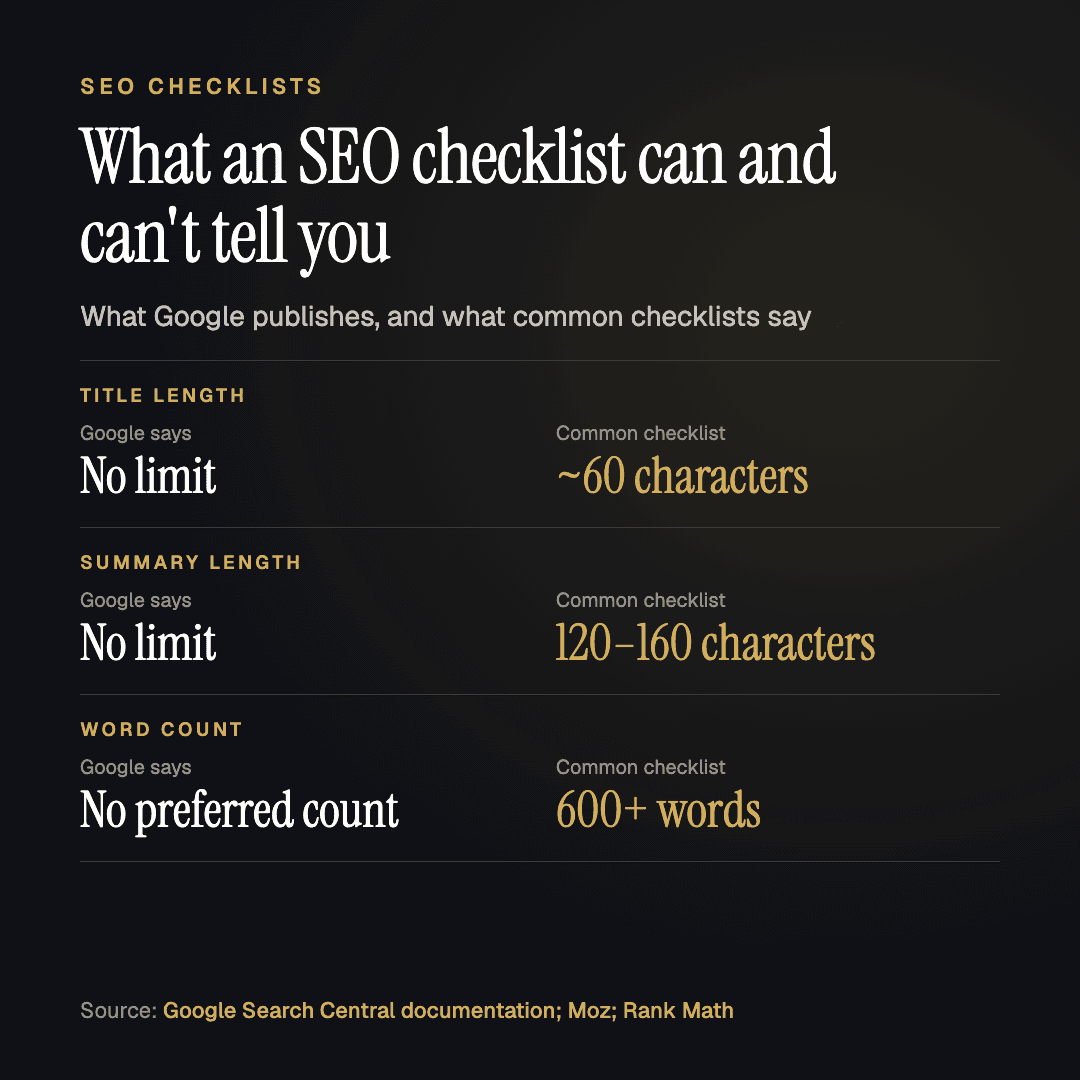
What an SEO checklist can and can't tell you
Most SEO checklists state their rules with more confidence than Google does. A title of 60 characters or fewer, a description of 120 to 160, at least 600 words: you'll find these numbers in plugins and blog posts everywhere, and none of them appears in Google's own documentation. Google's SEO Starter Guide even says there are no secrets that will automatically rank your site first.
Our websites for plant sellers include a writing tab called Blog & Guides, and beside its editor sits an SEO checklist. We checked every item on it against what Google, the W3C and Meta publish, and reworded the lines that claimed more than those sources do. This guide explains what the checklist checks, which parts rest on Google's own advice, which are only rules of thumb, and what no checklist can measure.
What Blog & Guides does
Blog & Guides is where you write for your own site. A blog post is a story in your own voice. A guide answers a question customers search for, such as how to care for a plant you sell. Ideas become drafts, drafts become ready pieces, and nothing goes live until you publish it. Each piece can have a version in every language your site offers, and you publish each one separately.
While you write, the checklist updates beside the editor. It only advises: it never stops you from publishing. After you publish, the site handles the technical side: a page title and description, a canonical address, links between the language versions and a share image. On our Growth and Premium plans it also adds a sitemap entry, article structured data and a listing in the llms.txt file that AI tools read.
Checks that rest on Google's own advice
Four checks match what Google's documentation says, with the caveats noted.
- Your customers' words are in the title. Google's Search Essentials say to use the words people would use to look for your content, in prominent places such as the title and main heading. They don't say the exact phrase must appear. Google also matches synonyms, so a title that reads naturally is fine, and the checklist says so when the phrase isn't found as written.
- The phrase is in a heading. Google explains that if your keywords appear in headings or body text, a page might be more relevant. That is hedged on purpose, and it doesn't say headings count for extra.
- Every photo has a description. Google's image guidance calls alt text the most important attribute for image metadata, and it helps people who can't see the photo.
- A clear title and summary. Google asks for a descriptive, concise title and a short summary that's unique to the page.
Checks that are common practice, not Google's rules
Three checks are conventions, and the checklist now says so.
- About 60 characters for a title and 120 to 160 for a summary. Google sets no limit on either. It cuts them off to fit the screen, and it builds most snippets from the page's own text rather than your summary. The numbers are popular conventions, and you'll see them at SEO tools like Moz and Rank Math. They're a reasonable way to stay short and clear, so the checklist keeps them as a guide.
- The phrase is in the first paragraph. No Google page we read says this. It's a convention from SEO plugins, and it's also good writing: tell the reader early what the guide answers.
- About 600 words. Google says there's no magical word count target, minimum or maximum, and asks writers whether they're writing to a word count because they believe Google prefers one. (It doesn't.) We keep 600 as our own rule of thumb for answering a question fully, and the checklist labels it that way.
Two checks that are ours
Two items aren't about search at all. A link to a plant you sell gives a reader an easy next step, so it's there for your sales. A cover photo is the picture people see in your list of guides and in the preview when someone shares a piece. Google recommends large images, at least 1,200 pixels wide, for Discover, its feed of suggested pages, but it doesn't say a cover photo affects ranking.
What no checklist can check
Google's own advice puts the most weight on content written for people. Its questions for self-assessment ask whether a piece offers original information, a substantial and complete description of the topic, and clear sourcing, and they ask who wrote it, how, and why. A program can't answer those. It can't tell whether your care advice is true, whether you've grown the plant yourself, or whether a customer would leave knowing more than when they arrived.
That's why the checklist never blocks publishing, and why chasing a perfect score can backfire. Repeating a phrase to turn a check green is what Google calls keyword stuffing. Write the answer first, then use the checklist as a last read-through.
Where to learn more
Start with Google's own pages. They're written for site owners, not specialists.
- SEO Starter Guide: the plain-language overview, including a list of things you don't need to worry about.
- Creating helpful, reliable, people-first content: what Google looks for instead of a word count.
- Influencing your title links and controlling your snippets.
- Image SEO best practices.
- Images tutorial from the W3C on writing good alt text (English only).
If you'd like Blog & Guides on your own site, get in touch. Can ChatGPT find your business? covers the other half: making sure AI tools can read what you publish.
Ready to be found? Let's build it.
Whether you need a starter site today or a full managed build, the first conversation is free.